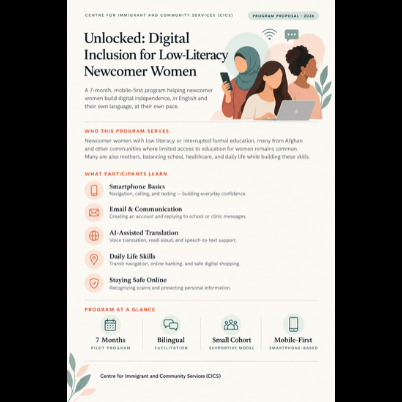
Many newcomer women in our community can think and speak clearly, but they cannot read or write well. Many are from Afghanistan, where girls often did not have the chance to go to school. In Canada, this makes daily life harder than it should be. A text from a child's school, a message from a clinic, or a bus route can feel impossible without help. Many of these women also feel unsure of themselves.
Our project will help newcomer women learn to use the tool they already carry every day, their own smartphone. Instead of a regular computer class, they will use voice, pictures and AI-assisted translation to handle daily life.
Over 7 months, a group of newcomer women originally from Afghanistan will meet once a week for 2 hours in a women-only group for around 20 sessions, led by a facilitator who speaks Dari. Each session mixes skills learning, time to talk and share tea or coffee, and peer support. In addition, each woman will get one-on-one help every week. We will start with the basics (calling, texting, using the phone with confidence). Then we will add email, translation and read-aloud tools, maps and transit apps, and online safety, including how to spot scams. Every stage includes extra time to repeat and practice, because this is how adults with little schooling learn best. Once the women are comfortable with the technology, we will introduce them to the tools of AI that is accessible by phones. We will teach them how to use those tools safely and avoid becoming victims of online crimes.
Women learn best from one another. The group provides a safe and welcoming space to build friendships, share tips, gain confidence, and celebrate achievements.
Most written manuals do not work for women who cannot read. We will create a video learning guide in English and Dari. Women can watch each lesson again on their own phones whenever they need a refresher, at home, at their own speed. They will also be taught to use AI tools to help them further their own learning.